
A CHAT GTP KOKC AM Radio Guthrie History
Introduction — A Personal Memory of 1490 AM in Guthrie, Oklahoma by Martin Blaney.
Having been born in Guthrie, Oklahoma, in 1962 and having lived here ever since, AM radio—especially during the late 1960s and early 1970s—was an important part of everyday life. For those of us growing up in Guthrie, our local station at 1490 AM, first KWRW and later KOKC, was simply part of the community.
Perhaps nothing made that more apparent to a school-age kid than bad weather. Before the Internet, cell phones, text messages, Facebook, and automated calls from the school district, you listened to the radio to find out whether school had been canceled. As far as I remember, KOKC was the primary—and perhaps the only truly “official”—local means of announcing weather-related closings for Guthrie Public Schools. When snow or ice moved in overnight, 1490 AM was where you listened the next morning to find out whether you were going to school.
I also have a much more personal memory of the station. When I was a Cub Scout, our pack was invited to tour the 1490 AM studios on North Division Street in downtown Guthrie. This wasn't merely a walk through the building. We were actually taken into the DJ's booth while he was broadcasting live. At one point he began talking to us on the air and asked one of the boys a question. For a group of Cub Scouts, actually standing inside the radio booth and suddenly becoming part of a live Guthrie radio broadcast was a pretty memorable experience. More than half a century later, I still remember it.
Throughout my childhood and younger years, the station's local content varied depending upon who owned and operated it. At different times there were DJ call-in requests, local news, Guthrie football, city council meetings, community announcements, and other locally produced programming. Some periods were much better than others, and local programming could be somewhat hit-and-miss as ownership changed through the years.
The last period when KOKC was personally useful to me was sometime around 1996, give or take a year. At the time, my morning commute took me from extreme southern Logan County north to the Kerr-McGee Cimarron facility south of Crescent.
I don't remember the exact business arrangement behind the program, but my recollection is that a local radio or ham-radio enthusiast had obtained or leased airtime from one of KOKC's numerous owners and was trying to make a go of a locally produced morning show. Much of the program consisted of the host simply reading stories from the Guthrie News Leader on the air. There was also an attempt to generate listener telephone calls, although very few people seemed to call. At the time I occasionally wondered whether some of the calls that did come in might have been friends or acquaintances helping keep the program moving.
None of that really mattered to me. For my morning drive across Logan County, it was perfect. I could listen to the local newspaper being read over the radio and hear a little conversation about what was happening around Guthrie.
Unfortunately, it didn't last.
There eventually came a period of little programming and even dead air, and the locally oriented KOKC that I remembered gradually disappeared. In 2004, the station became KMFS under Family Worship Center Church, associated with Jimmy Swaggart Ministries, and that programming continues on 1490 AM today.
I make no attempt to hide my personal feelings about that final change. I disliked it then and I still dislike it. Whatever its shortcomings under various previous owners, KWRW and KOKC had been Guthrie's radio station. It had carried our school closings, our football games, our local news, our meetings, our music and, occasionally, the voices of kids from a local Cub Scout pack standing nervously inside a downtown radio studio.
The transmitter remained. The frequency remained. The license still said Guthrie.
But, to me, Guthrie's radio station was gone.
— September 2, 2026
CHAT GTP Unedited Deep Dive:
From KWRW to KOKC: The History of 1490 AM in Guthrie, Oklahoma
For nearly seventy years, the AM frequency 1490 in Guthrie, Oklahoma, has been home to a broadcast facility with a surprisingly rich history. It began in the mid-1950s as KWRW, a 100-watt hometown radio station operating from Guthrie's historic Ione Hotel. In 1970 it became KOKC, a call sign that would remain associated with Guthrie for more than three decades. Along the way, the station trained aspiring disc jockeys, carried Spanish-language and Black-oriented programming, became closely identified with country music, broadcast Dallas Cowboys football and University of Oklahoma athletics, and used one of the most distinctive radio-station decals remembered in central Oklahoma.
Today the station survives as KMFS 1490 AM, but its roots go directly back to KWRW and KOKC.
The Birth of KWRW
Southern Broadcasting Company applied in April 1955 for authority to construct a new AM radio station in Guthrie. The proposed station would operate on 1490 kilocycles with 100 watts of power, unlimited hours, from a transmitter site described as being on U.S. Highway 77 at the north edge of Guthrie. The FCC approved the construction permit during the summer of 1955.
Southern Broadcasting was headed by James A. West Jr., Elgie M. Risinger and Delvin R. White. Their surnames are generally credited with supplying the meaningful letters in the new call sign: W-R-W, preceded by the western U.S. prefix K.
Before regular operation was fully established, the company decided to separate the studio from the transmitter. On September 21, 1955, the FCC approved remote operation from the Hotel Ione at 201 East Oklahoma Avenue in downtown Guthrie.
There has long been some confusion over whether KWRW began in 1955 or 1956. Surviving evidence settles the question fairly well.
A reception-verification letter dated November 9, 1955, sent by KWRW to a radio listener in Albuquerque, New Mexico, proves that the Guthrie station was already transmitting by that date. The stationery proudly identified KWRW as “1490 on your dial — full time” with studios in the Hotel Ione. The FCC did not grant the station's formal license until June 6, 1956, which probably explains why some later reference books use 1956 as the station's starting year.
For historical purposes, 1955 is the best date for KWRW's actual beginning.
Radio From the Ione Hotel
The 1957 Broadcasting Yearbook listed KWRW at 1490 AM, 100 watts, with the Ione Hotel as its address. It also gives us a snapshot of the people running the young Guthrie station.
J. A. West Jr. was president, Wes Ninemire was general manager and chief engineer, Bill Woodruff was program director, and Lucinda LeGate was women's director.
Ninemire appears to have been a genuine career broadcaster rather than simply a local businessman trying radio for the first time. He later became a manager and part-owner of stations in the Texas Panhandle.
By 1958, Charles Burton had been promoted to station and sales manager and Dick Carroll was named program director.
KWRW's presence in the Hotel Ione placed a working radio station squarely in the middle of downtown Guthrie during an era when local radio was still one of a community's primary sources of entertainment and information.
Three Downtown Studio Locations
FCC records allow KWRW's early studio movements to be reconstructed unusually well.
The station began with its remote-control studio at the Hotel Ione, 201 E. Oklahoma. On December 16, 1959, the FCC approved moving the studio and remote-control point to 108½ W. Harrison Avenue. The stay there was remarkably brief. On March 14, 1960, another authorization moved KWRW to 115 N. Division Street.
The Division Street location became KWRW's long-term home. A 1964 industry directory lists the station there with telephone number BU 2-2321, operated by Austin Oil Company. Helen Oven was president, David Oven vice president, Peggy Weems handled sales promotion and R. B. Phillips Jr. was chief engineer.
KWRW remained associated with 115 N. Division through the end of the KWRW era.
KWRW Even Operated a Disc-Jockey School
One of the most unusual discoveries in the station's history dates from 1959.
Broadcasting magazine reported that KWRW owner Farrell M. Brooks had established a school for disc jockeys at the Guthrie station. Students were taught to use the studio equipment and, more remarkably, were given their own programs on KWRW so they could gain genuine on-air experience before looking for jobs in broadcasting.
For a small 100-watt station in Guthrie, this was an ambitious undertaking. KWRW was not simply broadcasting to the community; for a time, it was also helping train the next generation of radio announcers.
A Surprisingly Diverse Radio Station
Although country music eventually became strongly associated with KWRW and KOKC, the station's 1960s schedule was considerably more varied.
KWRW carried statewide political broadcasts. In 1962, for example, it was among the Oklahoma radio stations carrying a campaign program for gubernatorial candidate Bill Atkinson.
A January 1964 newspaper advertisement lists a Gospel Hour on KWRW 1490 Guthrie. The Oklahoma Medical Research Foundation also identified KWRW as one of seventeen stations carrying its weekly informational broadcasts in 1964.
Perhaps most surprising is the amount of Spanish-language programming.
A federal directory of Spanish-language broadcasting identifies Peggy Weems as KWRW program director at 115 N. Division and reports that KWRW was airing 24 hours of Spanish programming each week. * (This is more than likely incorrect, firstly from my memory and secondly because of an online document GTP referred to that appears to point to perhaps a thirty or sixty minute show that probably paid for time? Martin B.)
For a small-town AM station in 1960s Oklahoma, twenty-four hours a week represented a substantial commitment to Spanish-speaking listeners.
Tommy Daniels and Black Radio in Guthrie
Another important chapter involves Guthrie native Tommy L. Daniels, who later became a television newsman and the first Black brigadier general in the Oklahoma Air National Guard.
A Daniels family history says that at age sixteen, while attending high school in Guthrie, Daniels began broadcasting on KWRW 1490 and was given one hour each night. The family account describes it as Guthrie's first Black radio station and says the young Daniels interviewed performers including James Brown.
Technically, Daniels did not create a separate FCC-licensed station—KWRW had already existed since 1955. The description almost certainly refers to the creation of a Black-oriented program or programming block within KWRW.
The story is particularly significant because Daniels was attending Faver High School during the segregation era. The Oklahoma Historical Society's Tommy L. Daniels Collection contains his 1965 Faver diploma and, notably, a Radio Telephone Third Class Operator Permit issued to Daniels in 1969, further documenting his early involvement in broadcasting.
A contemporary KWRW advertisement naming Daniels' program has not yet been located, so this portion of the station's history should be identified as family and oral-history evidence rather than fully documented contemporary newspaper evidence.
KWRW Becomes a Country Station
By the end of the 1960s, country music had become central to KWRW's identity.
A national music-industry directory published in October 1970 placed KWRW under the heading “C & W Exclusively.” It listed the station at 115 N. Division and named Dennis Spence as its contact.
That is important because it demonstrates that the station's country format was already established before the call letters changed.
KOKC Arrives
On December 15, 1970, KWRW officially became KOKC. The change is recorded on the station's FCC history card.
The new call letters were obviously useful for a station hoping to identify more closely with the growing Oklahoma City metropolitan area while remaining licensed to Guthrie.
At almost the same time, the station undertook its most important technical improvement since signing on.
Austin Oil Company received authority in 1971 to move the transmitter to a new site approximately one-quarter mile north of the I-35 and State Highway 33 junction, just off a county road. The FCC documents give the coordinates as 35°52′56″ N, 97°23′34″ W. Power was increased to approximately 500 watts during the day and 250 watts at night. The upgraded facility was placed into licensed operation in 1972.
It was, in effect, the beginning of a new era for 1490 AM.
The Famous KOKC Guitar Decal
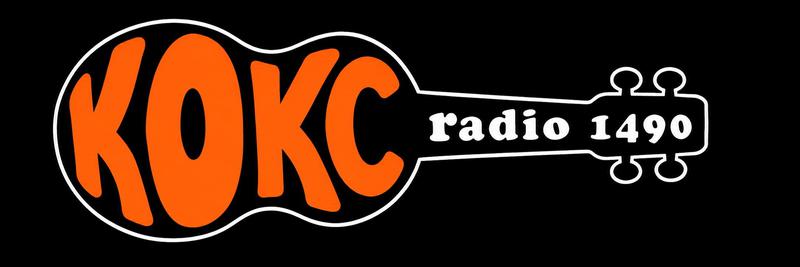
One of the most memorable pieces of KOKC history was its guitar-shaped station decal, apparently used during the early 1970s.
A surviving black-and-white reproduction of the genuine artwork has now been located. It confirms that the KOKC logo itself was incorporated into the body of a horizontally positioned guitar, with the words “radio 1490” extending along the neck.
The original decal above is remembered as having a black guitar background surrounded by a thin white outline, with large orange KOKC letters filling the guitar body. The KOKC letters were tall, rounded and slightly slanted, giving the design a distinctive early-1970s appearance. “radio 1490” appeared in white along the neck.
Proctor and Pioneer
In March 1974, the FCC approved a corporate-name change for KOKC's licensee to Proctor Inc.
In 1978, Proctor sold KOKC to Pioneer Broadcasters Inc. for $170,000. At that time the station was operating at 500 watts daytime and 250 watts nighttime. Pioneer was associated with members of the Moon and Brewer families, several of whom had other Oklahoma broadcasting interests.
The station continued its country-oriented identity into the 1980s.
KOKC and the Dallas Cowboys
KOKC became part of a much larger sports-radio network during the early 1980s.
The 1982 Dallas Cowboys Media Guide lists Guthrie — KOKC among the Oklahoma affiliates of the Cowboys Radio Network.
That meant Dallas Cowboys games could be heard in Guthrie and the surrounding area over the same 1490 frequency that had started as a tiny 100-watt hometown station less than thirty years earlier.
Reaching Toward Edmond and Oklahoma City
By the late 1980s and early 1990s, KOKC was increasingly acting like a north Oklahoma City metropolitan station, rather than merely a Guthrie station.
In August 1990, the Edmond Evening Sun reported that KOKC 1490 would broadcast every Edmond Memorial High School football game that season. Tony Sellars handled play-by-play, with former University of Oklahoma All-Americans Steve Zabel and Darrol Ray providing commentary.
The station's power eventually reached 1,000 watts, a considerable improvement over KWRW's original 100 watts.
Ownership Changes and an Unstable 1990s
Like many independent AM stations, KOKC went through a turbulent period as radio ownership and listening habits changed during the 1990s.
In 1995, Griffith Broadcasting purchased KOKC from OKC Ltd., a subsidiary of Larry Jones International Ministries, for approximately $70,000. At the time KOKC was identified as a classic-country station operating at 1,000 watts.
The following year, Oklahoma Sports Properties acquired the station. Trade publications listed KOKC as a 1,000-watt country outlet.
By 1999, KOKC had fallen silent. Fox Broadcasting Company purchased the station from Oklahoma Sports Properties for $120,000, and the seller was required to restore the facility to operating condition.
Despite those difficulties, KOKC still had another significant sports chapter ahead.
Home of OU Baseball
In 2000, KOKC became one of the primary radio outlets for University of Oklahoma baseball.
OU announced that every Sooner baseball game would be broadcast on KNOR 1400 Norman and KOKC 1490 Guthrie, with Mark Mathew handling play-by-play and Mike Treps serving as analyst.
KOKC also participated in other OU sports broadcasts; for example, an NCAA women's basketball tournament game in March 2000 was carried over KNOR and KOKC.
It was a remarkable role for a facility that had started forty-five years earlier with only 100 watts.
The End of KOKC in Guthrie
The final major ownership change came when Family Worship Center Church Inc., associated with Jimmy Swaggart Ministries, purchased KOKC for approximately $150,000. The transaction described the 1490 facility as 1,000 watts day and night and noted that the station was dark at the time.
On August 20, 2004, the FCC changed the Guthrie station's call letters from KOKC to KMFS.
The KOKC calls were subsequently placed on 1520 AM in Oklahoma City, the former KOMA.
That distinction is important:
Guthrie 1490 lineage Oklahoma City 1520 lineage
Oklahoma City 1520 lineageKWRW → KOKC → KMFSKFJF → KOMA → KOKC
KFJF → KOMA → KOKCThe present KOKC 1520 in Oklahoma City is not the old Guthrie station moved to Oklahoma City. Only the four-letter call sign changed stations.
The Station Today
The original Guthrie 1490 facility remains licensed as KMFS, FCC Facility ID 50165, to Guthrie, Oklahoma. FCC records identify Family Worship Center Church Inc. as the licensee of 1490 AM.
Modern listings show KMFS operating with approximately 1,000 watts full time and carrying religious programming.
Although the call letters and programming are very different, the station represents the continuation of the same Guthrie radio facility whose story began with KWRW in 1955.
Condensed Timeline
YearEvent
Event1955Southern Broadcasting receives authority for a new 1490-AM station in Guthrie; KWRW is broadcasting by November.
Southern Broadcasting receives authority for a new 1490-AM station in Guthrie; KWRW is broadcasting by November.1955–59Studios operate from the Hotel Ione.
Studios operate from the Hotel Ione.1959KWRW establishes a disc-jockey training school.
KWRW establishes a disc-jockey training school.Dec. 1959Studio moves briefly to 108½ W. Harrison.
Studio moves briefly to 108½ W. Harrison.Mar. 1960Studio moves to 115 N. Division.
Studio moves to 115 N. Division.1960sKWRW airs local music, gospel, public affairs, sports and extensive Spanish-language programming.
KWRW airs local music, gospel, public affairs, sports and extensive Spanish-language programming.circa 1963–65Tommy Daniels reportedly hosts a nightly Black-oriented program on KWRW.
Tommy Daniels reportedly hosts a nightly Black-oriented program on KWRW.1970KWRW is documented as an all-country station.
KWRW is documented as an all-country station.Dec. 15, 1970Call letters change to KOKC.
Call letters change to KOKC.1971–72Transmitter moves near I-35/SH-33 and power increases.
Transmitter moves near I-35/SH-33 and power increases.early 1970sThe memorable KOKC guitar decal is in use.
The memorable KOKC guitar decal is in use.1974Licensee becomes Proctor Inc.
Licensee becomes Proctor Inc.1978Pioneer Broadcasters purchases KOKC for $170,000.
Pioneer Broadcasters purchases KOKC for $170,000.1982KOKC is a Dallas Cowboys Radio Network affiliate.
KOKC is a Dallas Cowboys Radio Network affiliate.1990KOKC broadcasts Edmond Memorial football.
KOKC broadcasts Edmond Memorial football.1995–99Multiple ownership changes; station experiences periods of silence.
Multiple ownership changes; station experiences periods of silence.2000KOKC broadcasts every OU baseball game with KNOR Norman.
KOKC broadcasts every OU baseball game with KNOR Norman.2003–04Family Worship Center acquires the station.
Family Worship Center acquires the station.Aug. 20, 2004KOKC becomes KMFS.
KOKC becomes KMFS.Today1490 AM remains licensed to Guthrie as KMFS.
1490 AM remains licensed to Guthrie as KMFS.Historical Significance
KWRW/KOKC was never one of Oklahoma's giant 50,000-watt stations, but that is precisely what makes its story interesting. It was local radio in the traditional sense: a station where Guthrie residents could hear hometown personalities, church broadcasts, politics, country records, sports and community announcements.
At different points it also reached beyond what one would expect from a small-town AM outlet. It trained aspiring broadcasters, devoted substantial airtime to Spanish-language programming, provided an early platform for Tommy Daniels, carried Dallas Cowboys football, reached into Edmond and the Oklahoma City market, and became a principal outlet for University of Oklahoma baseball.
And for at least part of the 1970s, it promoted itself with a wonderfully simple piece of radio artwork: a black guitar, a white outline and four large orange letters—KOKC.
That guitar decal may be one of the best surviving visual symbols of the period when 1490 AM truly was Guthrie's radio station.
Research: 1955 KWRW verification letter showing “1490 on your dial,” Hotel Ione studios and the November 9, 1955 date: View the original KWRW document
1970 federal record showing KWRW Guthrie on 1490, then operating at 100 watts and requesting a power increase: View the Federal Register record
Federal directory documenting Peggy Weems, the 115 N. Division studio and 24 hours per week of Spanish-language programming: View the Spanish-language broadcasting directory
Tommy Daniels' family history describing his teenage KWRW program in Guthrie: Read the Tommy Daniels history
Oklahoma Historical Society's Brigadier General Tommy L. Daniels archival collection: View the OHS Daniels finding aid
1982 Dallas Cowboys Media Guide listing KOKC in Guthrie as a Cowboys Radio Network affiliate: View the 1982 Cowboys Media Guide
August 10, 1990 Edmond Evening Sun article stating KOKC 1490 Guthrie would broadcast all Edmond Memorial football games: View the original newspaper page
University of Oklahoma's 2000 announcement that every Sooner baseball game would air on KNOR Norman and KOKC Guthrie: View the OU announcement
Current station history showing the Guthrie 1490 lineage KWRW → KOKC → KMFS: View the KMFS station history.
Logo recreated by C GTP from Martin's memory.

If you have anything to add leave a message in this guestbook. MDB, Thanks!
